

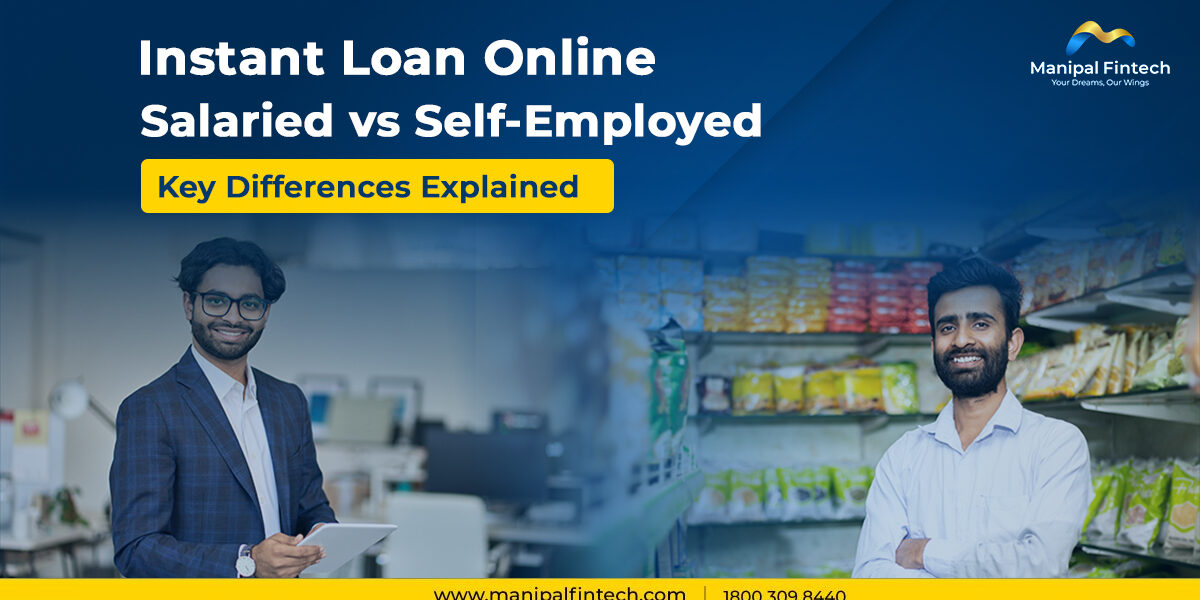
A personal loan is the most trusted and quickest way to get funds when you need it. However, how you’re employed – salaried at a job, running your own business, or freelancing – makes a real difference to how lenders assess your personal loan application. This guide breaks down the key differences between an instant personal loan for salaried employees and self-employed borrowers, including eligibility, documentation, interest rates, approval timelines, and the practical steps each category can take to secure the best offer.
Why Employment Type Matters for Personal Loans
According to the RBI’s latest Quarterly BSR-1 release for June 2026, personal loans in India registered 12.7% year-on-year growth, with bank credit overall accelerating to 16.5% – significantly higher than 9.9% a year ago. Personal loans continue to be one of the fastest-growing categories in Indian retail credit. But how easily you can access one – and at what rate – depends on how lenders classify your income.
Data from CMIE and LiveMint pegs India’s salaried workforce at roughly 8.4 crore employees, alongside 1.2 crore freelancers and gig workers and a much larger self-employed and business-owner base. All of them borrow personal loans – but not on the same terms.
At the heart of it, lenders price personal loans on one metric: how confident they are that your monthly EMI will hit their account for the full tenure of the loan. Salaried borrowers offer the highest confidence – a fixed employer transfer, every month, on the same date. Self-employed borrowers and freelancers, no matter how much they earn, have inherent income variability that lenders build risk premiums around.
This one difference influences everything – your interest rate, your loan amount, your paperwork, and how quickly your money arrives.
What is an Instant Personal Loan for Salaried Employees?
A personal loan for salaried employees is designed for individuals earning a fixed monthly salary from a private company, government organisation, or public sector undertaking. Key features:
- Fixed monthly income makes underwriting straightforward
- Approval typically within few hours; disbursal often same-day
- Documentation is minimal – mostly your PAN, salary slip, Form 16 and bank statement
- Pre-approved offers are common for existing bank customers
- Interest rates typically range between 9.90% and 15% per annum
Get instant personal loan online with Manipal Fintech at 9.99% per annum interest raates
What is an Instant Personal Loan for Self-Employed Borrowers and Freelancers?
Self-employed borrowers include business owners, consultants, freelancers, professionals (doctors, CAs, lawyers) and gig workers. Their income is real and often substantial, but it comes from clients, business activity, or contracts rather than a monthly salary credit. Key features:
- For a personal loan for a self-employed applicant, income is assessed through Income Tax Returns (ITRs), bank statements, and business documents
- Approval typically takes 3 to 7 working days due to manual verification
- Documentation is heavier – ITRs of 2-3 years, audited financials, GST registration
- Personal loans for self-employed borrowers have Interest rates that typically range between 12.5% and 20% per annum
- Loan amounts may be slightly lower relative to declared income
The one point worth stating clearly: a self-employed borrower earning ₹1 lakh a month in actual cash flow is not automatically at a disadvantage – but they need to make sure their paperwork reflects that income properly.
Key Differences at a Glance
| Parameter | Salaried | Self-Employed / Freelancer |
| Income source | Fixed monthly salary | Variable business or client income |
| Minimum income | ₹15,000 per month (20,000 or 25,000 for a few lenders) | ₹3 lakh per year net income |
| Documentation | Salary slips, Form 16, bank statement | ITRs (2-3 years), audited financials, GST, bank statements |
| Business/job vintage | 6 to 24 months at current employer | 2 to 3 years of established business |
| Interest rate | 10.5% to 15% p.a. | 12.5% to 20% p.a. |
| Loan amount | Higher, based on stable salary | Slightly lower, based on ITR income |
| Tenure options | Up to 7 years | Typically up to 5 years |
| Approval timeline | 24 to 48 hours | 3 to 7 working days |
| Minimum CIBIL | 700+ (750+ for best rates) | 700+ (750+ for best rates) |
| Collateral | None | None |
The 2-4% Interest Rate Gap – What It Actually Costs You
Everyone talks about the interest rate gap between salaried and self-employed borrowers. It’s worth putting it in real numbers.
Scenario: ₹5 lakh personal loan, 3-year tenure.
For a salaried borrower at 11% p.a.:
- EMI: ₹16,369
- Total repayment: ₹5,89,300
- Total interest paid: ₹89,300
For a self-employed borrower at 14% p.a.:
- EMI: ₹17,088
- Total repayment: ₹6,15,168
- Total interest paid: ₹1,15,168
The self-employed borrower pays ₹25,868 more in interest for the same loan, over the same tenure.
Scale that up. On a ₹10 lakh personal loan over 5 years, the same 3% rate difference adds up to over ₹85,000 in extra interest – nearly enough to buy a decent bike.
Pro Tip: Even a 1% rate reduction on a ₹5 lakh loan over 3 years saves you around ₹9,000. If you’re comparing offers, focus on the total interest payable – not just the EMI. Two loans with the same monthly EMI can have very different lifetime costs.
How Loan Amount Eligibility Actually Differs (FOIR Explained)
Lenders use the Fixed Obligation to Income Ratio (FOIR) to calculate how much loan you qualify for. Generally, total EMIs (existing + new) should not exceed 50-55% of your monthly income for salaried applicants.
For self-employed borrowers, the calculation is stricter.
Salaried applicant earning ₹50,000/month, no existing EMIs:
- Available EMI capacity (50% FOIR): ₹25,000
- Supports a loan of roughly ₹8-9 lakh at 12% over 3 years
Self-employed applicant with ₹50,000 average monthly income (ITR-based):
- Lenders often apply a 20% income buffer for variability → effective income considered as ₹40,000
- Applied FOIR is often tighter – 40% instead of 50%
- Available EMI capacity: ₹16,000
- Supports a loan of roughly ₹5-5.5 lakh at 14% over 3 years
Same income on paper – very different loan amounts sanctioned.
Self-employed borrowers can qualify for 30-40% smaller loans than salaried peers with the same declared income, purely because of how the eligibility math is structured. This is worth knowing before you apply – it prevents disappointment when the sanctioned amount comes in lower than expected.
How ITR Filing Can Influence Loan Eligibility For Self-Employed & Freelancers
For self-employed professionals and freelancers, Income Tax Returns (ITRs) are an important part of demonstrating income and repayment capacity.
Many self-employed individuals use legitimate tax-planning provisions, including deductions, presumptive taxation under Section 44AD and eligible business expenses, to manage their taxable income efficiently. However, when applying for a personal loan, the income reflected in the ITR can play an important role in determining eligibility.
For example, a business owner may have ₹15 lakh in annual business cash flow but report ₹6 lakh as net taxable income after applicable deductions. Since lenders typically consider documented income as part of their assessment, the eligible loan amount may be based on the ₹6 lakh income reflected in the ITR rather than the higher business cash flow.
Planning Ahead for Your Loan
If you anticipate applying for a personal loan in the next 6–12 months, discussing your borrowing plans with your CA can help you plan your finances accordingly. Maintaining accurate, consistent and well-documented income records can help present a clear picture of your financial capacity when you apply.
The objective is to ensure that your financial documentation accurately reflects your income profile and supports your borrowing requirements.
Common Challenges Self-Employed Borrowers Face (and How to Solve Them)
- Challenge: Irregular income documentation
Solution: Maintain separate business and personal bank accounts. File ITRs consistently, even for years when income is lower. A clean paper trail is worth more than a strong single year of earnings. - Challenge: Higher interest rates
Solution: Apply through multi-lender platforms where NBFCs specialising in self-employed profiles compete for your business. Some NBFCs offer significantly better rates than banks for self-employed applicants. - Challenge: Longer approval times
Solution: Prepare all documents in advance – ITRs, audited financials, GST certificate, bank statements. Applications with complete documentation get approved 2-3 days faster. - Challenge: Loan amount haircut
Solution: Add a co-applicant with a strong income profile – spouse, parent, or sibling. This can substantially increase the sanctioned loan amount.
What Salaried Borrowers Should Still Watch Out For
Being salaried doesn’t automatically give you the best deal. Two mistakes to avoid:
-
- Compare available loan offers
Your existing bank can be a convenient option, but it is worth comparing offers from 2–3 lenders to evaluate the interest rate, fees, tenure and overall cost. A small difference in the interest rate can make a meaningful difference to the total repayment over the loan tenure. - Choose a loan amount that suits your requirement
Your eligible loan amount may be higher than what you actually need. Choosing an amount aligned with your financial requirement can help keep your EMI and overall interest cost manageable. Consider your current needs, monthly budget and repayment capacity when deciding the loan amount.
- Compare available loan offers
Key Takeaways
- Salaried borrowers gets perosnal loan benefits like faster processing, simpler documentation and competitive interest rates, while self-employed borrowers may have additional documentation requirements and timelines as lenders assess their broader income profile.
- Interest rates can vary by borrower profile, lender and loan terms. Even a 2–4% difference can have a meaningful impact on the total interest payable over the loan tenure.
- FOIR calculations help lenders assess repayment capacity. For self-employed borrowers, lenders may consider income variations while determining the eligible loan amount.
- Self-employed borrowers can strengthen their loan applications by maintaining accurate ITRs, separate business bank accounts, up-to-date GST filings and well-organised financial records.
- Salaried borrowers can benefit from comparing offers across 2–3 lenders and choosing a loan amount that aligns with their actual financial requirement.
- Regardless of your employment profile, maintaining a healthy CIBIL score, keeping documents ready and comparing suitable loan offers can help you make a well-informed borrowing decision.
Whether you’re salaried or self-employed, compare personalised loan offers and apply for a personal loan on Manipal Fintech today.
Enquire Now on
www.manipalfintech.com,
or call at
18003098440
2 Comments