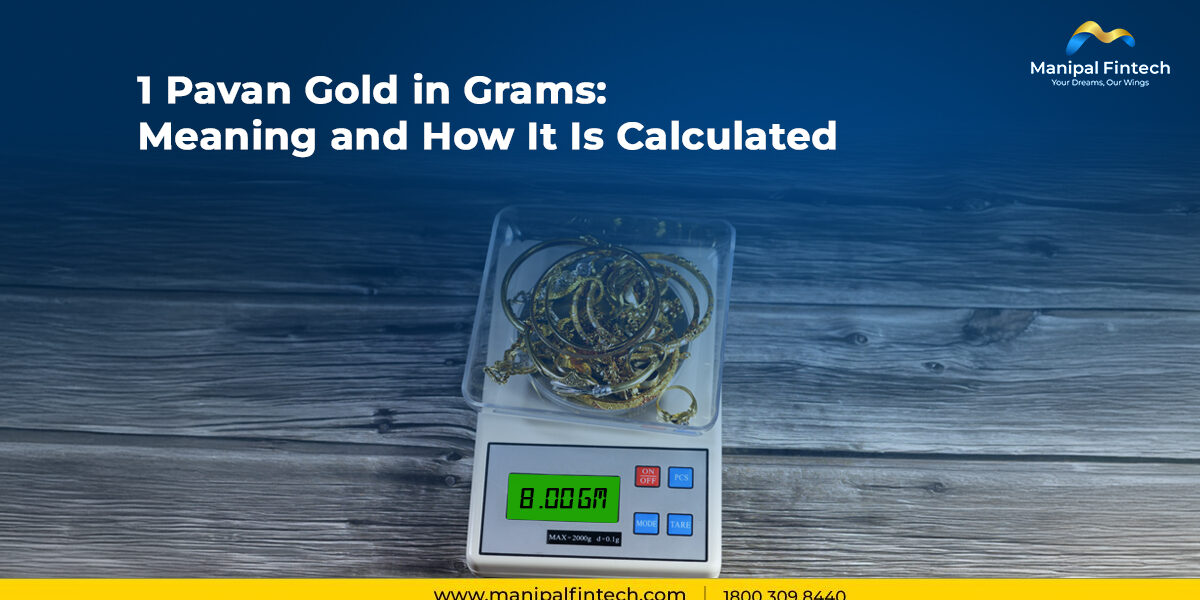
People who grew up in Kerala, Tamil Nadu, or Karnataka, have heard the word “pavan” long before they understood gram. Wedding jewellery, festival gifts and family gold – all measured in pavans. But when you walk into a modern jewellery store, apply for a gold loan online, or check the day’s gold rate, everything is quoted in grams.
Knowing exactly what 1 pavan gold means in grams and how it translates into value – helps you make confident financial decisions, whether you’re buying, selling, or pledging gold.
Why Gold Weight Units Matter in India
Indian households own more than 34,000 tonnes of gold, according to World Gold Council estimates. That’s more than the combined official reserves of the US, Germany and IMF put together.
Much of this gold sits in family lockers, cupboards and vaults across India. Southern regions hold over 40% of the total household gold india – where traditional measurement units like pavan and savaran remain part of everyday conversation. A grandmother describing her daughter’s wedding jewellery as “twelve pavan” makes perfect sense to a Kerala or Tamil Nadu family. The metric gram, though it dominates official transactions, runs alongside these traditional units in daily use.
If you don’t understand the pavan-to-gram conversion, you can end up overpaying at a jewellery store, underestimating your gold’s value at a loan pledge, or getting confused when a jeweller quotes a rate per pavan while your online research shows rates per gram. A clear grasp of what 1 pavan means in grams removes this confusion completely.
What is 1 Pavan and How Much Does It Weigh?
1 pavan of gold is equal to 8 grams.
This is the standard used across all South Indian gold markets – Kerala, Tamil Nadu (where it’s often called savaran), Karnataka and parts of Andhra Pradesh. Whether it’s a gold chain, a bangle, or a coin, the pavan-to-gram conversion remains the same: multiply the pavan count by 8 and you get the weight in grams.
The Traditional Origins of Pavan
The word “pavan” traces its origins to the British Sovereign gold coin. During the Great Recoinage of 1816-1817, the Sovereign coin was minted at a weight of 7.98805 grams – which everyday trade rounded to exactly 8 grams for simplicity.
The Sovereign coin circulated widely in British India, particularly in coastal trading regions. Local merchants in Kerala adopted the term “pavan” to refer to this specific coin weight. Over time, 1 pavan came to mean an 8-gram unit of gold, regardless of whether the actual object was a coin, a piece of jewellery, or a bar.
Even after India’s move to the metric system, the pavan unit stayed embedded in everyday South Indian trade. Today, a shopkeeper in Kochi and a customer at his counter share an instant, unspoken understanding of what “one pavan” means – the same understanding their grandparents had a hundred years ago.
Simple Conversion Formula
The formula for converting pavan to grams is a simple multiplication:
Number of pavans × 8 = Weight in grams
Here’s a quick reference:
- 1 pavan = 8 grams
- 2 pavans = 16 grams
- 3 pavans = 24 grams
- 5 pavans = 40 grams
- 10 pavans = 80 grams
- 12 pavans (typical wedding set) = 96 grams
- 15 pavans = 120 grams
- 20 pavans = 160 grams
If you’re ever unsure, a simple multiplication by 8 gives you the exact gram equivalent.
Calculating Gold Value Using Pavan Weight
Gold value in India depends on three things: the weight of the gold, its purity and the current market price per gram. Measuring in pavan doesn’t change this math – you just need the gram equivalent first.
Market Value Calculation
For any gold value calculation, the formula is:
Weight in grams × Current gold rate per gram = Market value
For example, if today’s gold rate is ₹14,500 per gram for 22-karat gold, then 1 pavan (8 grams) is worth ₹1,16,000. A 2-pavan chain (16 grams) is worth ₹2,32,000. A 12-pavan wedding set (96 grams) is worth ₹13,92,000 – before any making charges, GST, or design premiums.
Because gold prices in India change daily based on international rates, currency movements and domestic demand, always check the current rate before making a decision. A ₹100 change in the per-gram price of gold translates directly into significant swings on larger holdings.
Loan Amount Estimation Using Pavan Weight
Gold loans in India are sanctioned based on the market value of the pledged gold, subject to the RBI-mandated Loan-to-Value (LTV) cap of 75%.
Here’s how the calculation works:
- 3 pavans (24 grams) at ₹14,500/g = ₹3,48,000 market value → maximum loan of ₹2,61,000 at 75% LTV
- 5 pavans (40 grams) at ₹14,500/g = ₹5,80,000 market value → maximum loan of ₹4,35,000 at 75% LTV
- 10 pavans (80 grams) at ₹14,500/g = ₹11,60,000 market value → maximum loan of ₹8,70,000 at 75% LTV
Different lenders may offer slightly different per-gram rates depending on their valuation methods and the specific loan scheme.
Using Pavan for Gold Transactions
Pavan remains the working unit in a large number of South Indian gold transactions. Knowing how it converts saves time and prevents pricing confusion.
Jewellery Purchase Planning
When you walk into a jewellery store in Kerala or Tamil Nadu, prices are often quoted per pavan rather than per gram. A salesperson might say “this necklace is one and a half pavan” – meaning it weighs 12 grams.
To evaluate whether you’re getting fair value, cross-check the pavan quote with the current per-gram rate:
- Ask for the gold’s purity (22-karat is standard for jewellery, sometimes 18-karat for lighter designs)
- Multiply the pavan weight by 8 to get grams
- Multiply grams by the day’s per-gram rate for that purity
- Add making charges (typically 8-15% for 22K jewellery) and GST (3%)
This gives you the total expected price. Any significant deviation should prompt a question. Reputable jewellers will always show you the weight, purity and per-gram rate breakdown – so you can verify the math yourself.
For wedding jewellery planning specifically, the pavan unit is extremely useful. A traditional wedding set of 12 pavans (96 grams) is a common benchmark for many South Indian families. Knowing this upfront helps you budget realistically and avoid surprises during shopping.
Gold Loan Applications Using Pavan Measurements
When applying for a gold loan, you can state your gold’s weight in pavans. The lender’s system converts it to grams using the standard 1 pavan = 8 grams ratio, then calculates the loan amount based on current gold prices and the LTV cap.
For example, if you pledge 5 pavans (40 grams) of 22K gold, the lender’s process is:
- Convert pavan to grams: 5 × 8 = 40 grams
- Assess purity: 22K = 91.6% pure
- Calculate 24K equivalent gold: 40 × 0.916 = 36.64 grams
- Multiply by current 24K gold rate: 36.64 × ₹14,500 = ₹5,31,280
- Apply LTV of 75%: ₹5,31,280 × 0.75 = ₹3,98,460 maximum loan
A lender may adjust the calculation slightly based on their internal safety margins and scheme-specific rates..
Comparing Traditional and Modern Gold Units
India uses several gold weight units across its regions. Knowing how they relate prevents mix-ups when you’re dealing with gold from different parts of the country.
Regional Variations in Gold Measurement
- Pavan (Kerala): 8 grams, standard South Indian unit
- Savaran (Tamil Nadu): 8 grams, same as pavan, just a different regional name
- Gram (Karnataka, most of India): the metric standard, universally understood
- Tola (North India): 11.66 grams & somewhere 10 grams, traditional unit used in Delhi, Punjab, UP, Rajasthan
- Ratti (traditional): approximately 0.121 grams, used mainly for gemstones and very small gold quantities
If you inherit or receive jewellery labelled in tolas, you’ll need a slightly less clean conversion: 1 tola ~ 11.66 grams or ~10 grams or ~ 1.46 pavans. It’s not a neat number, so use a calculator or a converter tool.
Understanding these regional variations means you won’t be caught off-guard when you encounter an unfamiliar unit. A pavan in Kerala, a savaran in Tamil Nadu and a certain weight in tolas from a North Indian family all describe the same underlying commodity – just measured differently.
In a Nutshell
1 pavan of gold equals 8 grams. This simple conversion is the key that unlocks accurate gold valuation across South India.
Whether you’re planning to buy a wedding jewellery set, estimating the worth of ancestral bangles, or applying for a gold loan, remembering this number puts you in control of the transaction. Multiply the pavan count by 8 to get grams. Multiply grams by the current per-gram rate to get market value. Apply the 75% LTV cap to get your maximum gold loan amount.
For anyone dealing with gold in Kerala, Tamil Nadu, or Karnataka – as a buyer, seller, or borrower – mastering this one calculation adds real financial clarity to every gold-related decision.